Kyushu Onsen for Older Travellers: Access, Walking and Bathing Options
Compare Ureshino, Beppu, Yufuin and Kurokawa for accessible bathing, transport, luggage support and walking demands on a Kyushu onsen trip.
“Senior-friendly” is too broad to be useful on its own. One traveller may be comfortable walking several kilometres but need a handrail getting into a bath. Another may use a wheelchair, need help with transfers, or simply prefer not to change hotels with a heavy suitcase. Choose the onsen town around the part of the day that is hardest for your group, then confirm the exact route from vehicle or station to room, bath and dining room.
| Area | A practical strength | What to check before booking |
|---|---|---|
| Ureshino | Siebold-no-Yu lists an accessible private bathing room and a shower chair that can be used for transfer from a wheelchair | Whether the equipment and staff support suit the bather’s specific transfer needs; the shinkansen station is not in the old town |
| Beppu | Municipal baths and transport give you alternatives if a longer outing becomes too much | Each bath is different; confirm the route, handrails and access to the actual tub, not just the building entrance |
| Yufuin | The station-area baggage service can store bags or deliver them to participating inns | The town still involves walking; delivery is limited to listed inns and has set reception times |
| Kurokawa | A ryokan-centred stay lets you keep most of the day in one place | The village is hilly, and the official site warns that two slopes are steep for wheelchair users |
This is a trip-planning comparison, not an accessibility certification. A ramp at the entrance does not establish that the route to a room, dining area or bath is step-free, and “private bath” does not automatically mean an accessible transfer.
Ureshino: the clearest published bathing support
Siebold-no-Yu is a useful first place to investigate when the bath itself needs to accommodate a wheelchair user. Saga’s Sagas Style accessibility listing describes a private accessible bath where the bather can transfer from a wheelchair to a dedicated shower chair and continue into the bath. It also lists a loan wheelchair, elevator, handrails around the facility and accessible toilet. These details are more useful than a general “barrier-free” label, but the facility should still confirm whether its layout and equipment fit the person using them.
The bath is in Ureshino’s older town centre. The prefectural listing gives a six-minute walk from Ureshino Bus Center, while a taxi is a practical option from Ureshino-Onsen Station. Do not plan to pull a suitcase along the whole route simply because the station and town share the word “Onsen.” The municipal public bath opens from 6 a.m. to 10 p.m., with last entry at 9:30 p.m.; the third Wednesday is its regular closing day. Its page lists general adult admission at ¥450.
The town also has footbaths and places to sit, so the rest of the group can keep the day pleasant without everyone needing to use a full bathing facility. For more on the area’s day-use choices, see the Ureshino onsen guide.
Beppu: useful when you want a backup plan nearby
Beppu works well for travellers who prefer to keep alternatives close. Staying near the station means a tired group can shorten the day without cancelling the entire onsen outing. The city’s municipal baths vary in layout and location; some are close to the central station area, while others call for a bus or train ride to another district.
For anyone who needs a wheelchair route into the bathing room, Beppu City documents facilities such as Furo-onsen with a dedicated bath wheelchair for entering the bathing area. Kiyosen in Kamegawa is another facility to investigate when handrails and bath access matter. These are specific features, not a promise that every part of the route will suit every visitor. Contact the bath to discuss transfers, steps at the tub edge and whether equipment will be available during your visit.
The ability to change course is Beppu’s practical advantage: choose one district, then keep a closer bath or the hotel’s own bath as the fallback. The Beppu municipal-bath guide compares public options; the Beppu station-area guide is a better starting point if avoiding long transfers is the priority.
Yufuin: send the bags ahead, but plan the walking
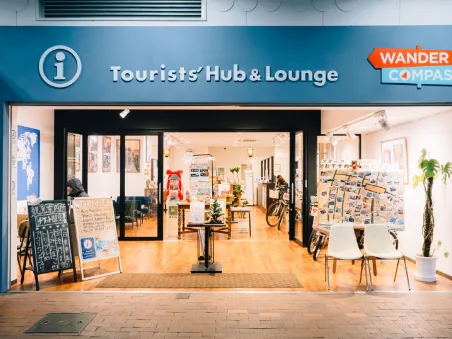
Yufuin has a helpful service for travellers arriving with luggage. Yufuin Chikki at the tourist information centre stores bags and can deliver them to participating inns; on departure day, an eligible inn can send bags back to the centre. Current handling and delivery hours are limited, and delivery is only available to inns on the association’s list, so check eligibility and cut-off times before relying on it.
That removes one strain from the day, but not the walking between the station, shops, restaurants and accommodation. A gentler plan might be to send the luggage ahead, choose one stretch of town for a walk, stop for lunch, and either use one day bath or go straight to the inn. Do not assume that because the town is described as walkable, a full sightseeing loop is comfortable for everyone.
JR Kyushu offers advance requests for assistance at stations and for wheelchair spaces on the Kyushu and Nishikyushu Shinkansen. The railway asks passengers to arrange assistance ahead of the trip; available support depends on the station and service. For bath choices and mobility-friendly pacing, see the Yufuin day-use guide and Yufuin stay-area guide.
Kurokawa: let the ryokan carry more of the day
Kurokawa’s official FAQ says the village has many slopes and specifically advises wheelchair users to avoid the steep Bettin-zaka and Igo-zaka. The tourist information office has one wheelchair available on a first-come basis; it cannot be reserved. That is not enough to build a wheelchair itinerary around without a backup plan.
If the hills are manageable but repeated walking is not, staying overnight and making the inn the centre of the trip can work better than trying to use all three visits on a bathing pass. Ask the ryokan about the full path from the drop-off point to the room, dining area and bath. Confirm stairs, elevators, distance between buildings, tub-edge height and whether a private bath can be entered with the equipment the guest uses. A photo of the guest room alone will not answer those questions.
The official Kurokawa no-car guide covers bus planning; the Kurokawa private-bath guide is useful when a private bathing room is part of the plan.
Questions that lead to a useful answer
When contacting a bath or inn, describe the assistance needed rather than asking only whether it is “barrier-free.” For example: Can the guest reach the bath without steps? Is there a handrail beside the tub? Can a wheelchair enter the washing area, or is a transfer required? Is a shower chair or bath lift available? Does the lift reach the booked room? Can staff help, and should assistance be arranged in advance?
Also plan a lower-effort version of the day. One main bath, a meal and time to sit down is often plenty. If a second stop is important, make it optional and nearby. Restrooms, a place to sit, transport frequency and the distance back to the accommodation may affect the day more than the number of baths available.
If bathing is medically restricted, check with the traveller’s clinician and follow the facility’s posted bathing guidance. Do not infer that a lower-temperature bath or a private room is medically safe for a particular person.
Sources
- Saga Style: [Siebold-no-Yu accessibility information](https://saga-style.jp/shop/detail.php?id=3085) — transfer chair, private accessible bath, elevator, loan wheelchair, hours and access. - Ureshino City: [Siebold-no-Yu](https://www.city.ureshino.lg.jp/kanko/siebold.html) — public-bath hours, admission and closure day. - Beppu City: [Furo-onsen](https://www.city.beppu.oita.jp/sisetu/shieionsen/detail5.html) and [Kiyosen](https://www.city.beppu.oita.jp/sisetu/shieionsen/kiyosen.html) — bath-wheelchair and facility information. - YUFUINFO: [Yufuin Chikki baggage service](https://yufuin.gr.jp/spot/spot-2295/) — current storage and delivery hours, fees and participating-inn restriction. - JR Kyushu: [Assistance for passengers with disabilities](https://www.jrkyushu.co.jp/railway/facility/barrier_free/assist/) — advance support requests and wheelchair seating. - Kurokawa Onsen Official Site: [Frequently asked questions](https://www.kurokawaonsen.or.jp/faq/) — wheelchair availability and steep-slope warning.Tags: Kyushu onsen, accessible onsen Japan, senior travel Kyushu, onsen with mobility needs, wheelchair accessible bath, Ureshino Onsen, Beppu Onsen, Yufuin Onsen, Kurokawa Onsen, accessible private bath, onsen ryokan planning, luggage delivery Yufuin, barrier-free travel Japan, Kyushu travel, Japan hot springs