Private Baths in Hirayama Onsen: In-Room, Reserved or Public?
Compare Hirayama Onsen’s in-room and private-use baths with Yunokura day bathing and Yamaga’s public Sakura-yu; the labels differ.
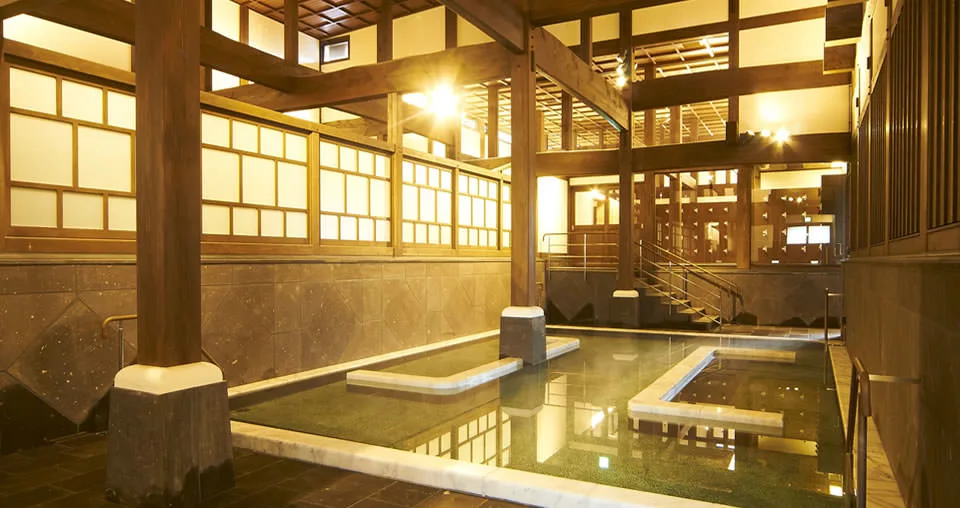
“Private bath” is a useful search term, but it does not tell you whether a bath is inside your room, reserved for a timed session, or simply separate from the main public bath. In Hirayama, check the named room or facility before you compare properties.
| Bath type | What you are booking | Best suited to |
|---|---|---|
| In-room open-air bath | A bath attached to a specific guest room, usually available on your own schedule | Travellers who value privacy or flexibility; verify whether the selected room’s bath is natural onsen water |
| Private family bath | A separate bath reserved for a set period; availability and reservation rules vary by facility | A family or small group who wants to bathe together without using the communal bath |
| Shared public bath | A communal bath open under the facility’s rules | Visitors who want the public-bath setting or a simpler day-use visit |
Yunokura makes the distinction clear. Its main building is the day-use facility, with shared indoor and large outdoor baths. It also lists a small number of private rooms with outdoor baths for day visitors; these require advance reservation.
Its overnight buildings have separate guest-only baths. Yunokura’s Jutei rooms are listed with individual open-air baths, while Fuku-tei and Bettei have their own guest facilities. Check the exact building and room plan; the property name alone does not tell you which bath is included.
Yunokura says the dedicated open-air baths in its overnight buildings use natural hot-spring water on a 100% flow-through basis. Treat that as a statement about those baths, not every room or every Hirayama property. The association’s regional spring profile—alkaline simple sulfur spring, source temperature around 40–60°C—does not tell you the water temperature in a particular room. Ask how that specific tub is supplied and managed, especially if a child or older guest is sensitive to heat.
The association describes Hirayama’s spring as alkaline simple sulfur, with source temperatures around 40–60°C. Yunokura separately lists its spring analysis and source temperature. Neither figure guarantees the temperature in a particular room bath at the time of use. If that matters, ask the property how the bath is supplied and temperature-managed.
Sakura-yu is a different experience: a historic public bath in central Yamaga, not a private-bath option. It can pair with a town visit before you check into Hirayama. For a broader look at public bathing, see the day-use comparison.
The two experiences can fit on the same day: visit Sakura-yu and the old streets first, then check into a Hirayama inn and use its private bath after dinner or early the next morning. If you only have half a day, choose one side and avoid the extra transfer. Families and guests with mobility needs should ask about steps, bath depth, seating, wash space and the room-to-bath route; private access does not automatically mean step-free access.
Check the specific room, building and reservation terms before booking.
Sources
- Yunokura, [spring details and guest-only bath list](https://www.yunokura.jp/onsen/), [day-use main building](https://www.yunokura.jp/guide/honkan/) and [Jutei guest rooms](https://www.yunokura.jp/guide/kotobuki/) - Hirayama Onsen Tourism Association, [spring characteristics](https://hirayama-onsen.jp/miryoku/) and [family-bath facilities](https://hirayama-onsen.jp/facilities/) - Yamaga Tourism Guide, [Sakura-yu](https://yamaga-tanbou.jp/sakurayu/)Checked: 2026-09-27.
Hirayama Onsen private bath, in-room onsen, reserved family baths, Yunokura, Sakura-yu.