Togura-Kamiyamada Onsen: How to Choose Among Seven Public Baths
Compare seven Togura-Kamiyamada public baths by price, hours and facilities—from ¥300 early-morning soaks to saunas, family amenities and flowing spring water.
Togura-Kamiyamada is a cluster of local bathhouses, not a single resort spa. Seven public baths take part in the Shichifukujin Sotoyu Meguri stamp rally, and their standard adult admission ranges from ¥300 to ¥800. The useful choice is usually one or two baths matched to your timing and priorities: the earliest opening, a low-price soak, a sauna, a more accessible layout or a family-friendly place to stay longer.
The tourism association’s listing was updated on July 23, 2026. The prices below are standard visitor rates; resident discounts, tickets, coupons and special morning or late-night pricing are separate. Confirm each bath’s calendar before travelling.
Compare the seven baths at a glance
| Bath | Standard adult admission | Listed hours | The clearest reason to choose it |
|---|---|---|---|
| Yu no Hana Sento Zuisho | ¥800 | Weekdays 9:00 a.m.–1:00 a.m.; weekends and holidays 6:00 a.m.–1:00 a.m.; last entry 12:30 a.m. | The broadest mix of pools and sauna; weekend early-bath rate |
| Tsuru no Yu | ¥400 | 9:00 a.m.–9:00 p.m. | Marketed as a barrier-free community bath |
| Yu no Moto Kamenoyu | ¥400 for non-residents | 10:00 a.m.–11:00 p.m.; last entry 10:30 p.m. | Traditional public bath with indoor, open-air and ceramic tubs |
| Yunosato Chikuma Hakuchoen | ¥700 | 9:30 a.m.–9:00 p.m.; last entry 8:30 p.m. | Open-air bath, sauna, dining and space to rest |
| Togura Kokumin Onsen | ¥380 | 8:30 a.m.–10:00 p.m. | The local tourism account says the baths, taps and showers use flowing source water |
| Manyo Onsen | ¥480 | 4:00 a.m.–11:00 p.m.; last entry 10:30 p.m. | Earliest opening, plus a preserved local train display |
| Togura Kanze Onsen | ¥300 | 4:30 a.m.–11:00 p.m. | Lowest standard adult price and an occasional clear green tint |
Regular closure days differ. Zuisho closes on the third Tuesday of each month; Tsuru no Yu on the first and third Wednesdays; Kamenoyu on the 16th and month-end; Hakuchoen on the second and fourth Tuesdays; Manyo on the fourth Monday, moving to Tuesday when that Monday is a holiday; and Kanze on the first and third Mondays. Kokumin Onsen lists one closure day in the early part of each month rather than a fixed date. Check the current listing for that specific bath.
For an early soak, choose by the clock
| Bath | Opens | Adult admission | Last entry / special rate |
|---|---|---|---|
| Manyo Onsen | 4:00 a.m. | ¥480 | Last entry 10:30 p.m. |
| Togura Kanze Onsen | 4:30 a.m. | ¥300 | — |
| Yu no Hana Sento Zuisho | 6:00 a.m. weekends / holidays; 9:00 a.m. weekdays | ¥800 | Closes 1:00 a.m.; last entry 12:30 a.m. Add ¥100 after 10:00 p.m. Weekend / holiday entry 6:00–9:00 a.m. is ¥650; guests may stay after 9:00 a.m. |
Manyo is the earliest option and about a 15-minute walk from Togura Station. The operator lists a simple sulfur spring with flowing spring water; a local 115-series train is displayed in the building. Kanze opens half an hour later. Its alkaline simple spring can look clear with a green cast; the colour alone does not indicate mineral concentration or strength.
Zuisho and Kokumin Onsen show two different ideas of “flowing water”
Zuisho is the most varied bathing complex in the group, with about eight bathing features, a sauna and cold plunge. Its indoor main bath and main outdoor bath use different mixed springs. The operator publishes the source temperatures separately: 45.5°C for the indoor spring and 44.8°C for the outdoor spring. Those are source-water figures, not fixed bathing temperatures. The main pools are heated by heat exchange, with no water added, recirculation or disinfection stated for those pools.
That description does not cover every tub. Zuisho says its outdoor ceramic tubs, reclining bath and Sasara bath combine the indoor and outdoor sources and use recirculation filtration and treatment chemicals. The jet bath uses ordinary heated water because the mechanism cannot handle the spring. A “flowing spring” label is therefore not a blanket description of every feature.
Kokumin Onsen has fewer facilities, but its distinction is simpler: the local tourism association’s preserved description says the baths, washing taps and showers all use 100% flowing source water. Standard adult admission is ¥380, and the bathhouse is open 8:30 a.m.–10:00 p.m. If the spring itself matters more than sauna or multiple pools, this is a clear, low-cost choice.
Traditional baths, a sauna and a place to stay longer
| Bath | Admission | Hours / last entry | Extra costs |
|---|---|---|---|
| Yu no Moto Kamenoyu | Non-resident adult ¥400 | 10:00 a.m.–11:00 p.m.; last entry 10:30 p.m. | Towel-and-soap set ¥200; small shampoo ¥120; bath towel ¥450 |
| Yunosato Chikuma Hakuchoen | Adult ¥700; age 6 through elementary school ¥350; younger children free | 9:30 a.m.–9:00 p.m.; last entry 8:30 p.m. | — |
| Tsuru no Yu | Adult ¥400; children under 12 free | See current listing | — |
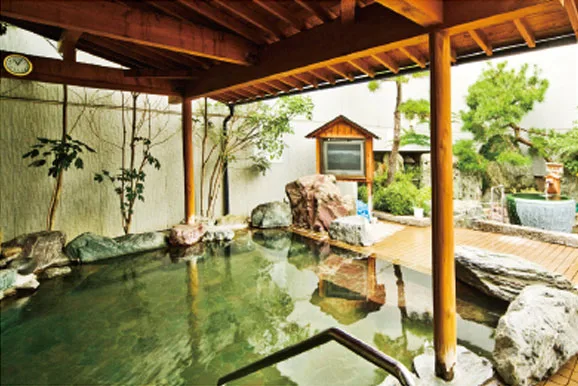
Kamenoyu has indoor, jet, open-air and ceramic baths. The tourism listing identifies an alkaline simple sulfur spring, and the property says its public baths use natural source water. Its larger renovation was completed in July 2024.
Hakuchoen has indoor and open-air baths, a sauna, dining and a rest room. The official listing classifies the water as an alkaline simple spring. Chikuma City’s older page describes a heated, recirculated indoor bath and a heated, flowing outdoor bath, but its posted prices do not reflect the newer 2026 rate; use the current tourism or facility listing for admission.
The tourism association describes Tsuru no Yu as a barrier-free community bath. Call ahead about the specific mobility support you need; the label does not confirm every ramp, handrail, changing-room dimension or pool entry.
Plan one or two baths, not a seven-stop bathing marathon
The seven-bath stamp rally is a fun way to explore the area, but it does not make seven full bathing sessions a sensible day plan. Heat, repeated bathing and dehydration add up. Pick two baths with different features, leave time to rest and drink water, and stop if you feel dizzy or unwell.
Without a car, Togura Station is a useful starting point; Manyo is about a 15-minute walk away. The other baths are spread between Togura and Kamiyamada, so check the walk to each one rather than assuming they form a compact five-minute circuit. If a long walk is difficult, arrange a taxi between locations. By car, choose around opening hours—Manyo or Kanze early, Hakuchoen or Kamenoyu during the day, Zuisho for a late finish—then park once where possible instead of rushing between seven brief visits.
For other public-bath comparisons in Nagano, see Bessho Onsen’s day-use guide, Kamisuwa’s public-bath guide, Shimosuwa’s public baths, Matsushiro day-use baths and the Yudanaka–Shibu day-trip and overnight comparison. If you are planning a longer visit, use the Kamisuwa day-trip itinerary or one-night guide. For spring data, see how to read onsen water temperatures and how Japanese spring classifications work.
Tattoo rules
Tattoo access is decided by each bathhouse, not by the wider area. Check the rule with your chosen facility before you go.
Sources and verification
- [Shinshu Chikuma Tourism Bureau: the seven public baths, rates, hours and closure days; updated July 23, 2026](https://chikuma-kanko.com/shichihukujin-sotoyumeguri/) - [Zuisho: current rates, hours, spring sources and bathing features](https://zuisho.com/spa.html) - [Zuisho: late-night fee notice](https://zuisho.com/news/post-761/) - [Kamenoyu: admission, hours, amenities and spring information](https://kamiyamada-onsen.co.jp/kamenoyu/) - [Hakuchoen: current facility information](https://hakuchoen.jp/) - [Chikuma City: Hakuchoen spring and treatment information](https://www.city.chikuma.lg.jp/kurashi_tetsuzuki/public_bath/8923.html) - [Togura Kokumin Onsen: tourism association description of 100% flowing use](https://chikuma-kanko.com/2024-01-15/post-42193/) - [Manyo Onsen: official facility information](https://manyoonsen-togura.com/)Checked: September 28, 2026.