Nishiyodogawa Sento Guide: Six Local Bathhouses Around Tsukamoto and Mitejima
Compare six Nishiyodogawa bathhouses by natural spring water, sauna, Sunday hours, station access and Osaka’s ¥600 standard admission.
For a natural hot spring, go to Hikari Nozato no Yu. For an early Sunday soak, Haccho Onsen is the standout. If you are staying near Tsukamoto or Himejima, the smaller local baths may be more convenient than crossing town for a larger spa.
| Bathhouse | Current listed hours | Nearest station | Useful distinction |
|---|---|---|---|
| Hikari Nozato no Yu | 2:00 p.m.–midnight; closed Tuesday | Tsukamoto or Mitejima, about 8 minutes on foot | The association describes an alkaline simple hot spring from 800 m underground; dry and steam saunas, carbonated bath, and rock bath. |
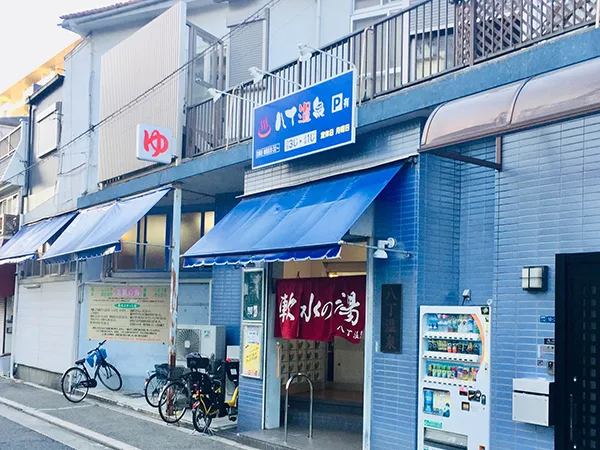
| Haccho Onsen | 3:00 p.m.–1:00 a.m.; Sunday morning 8:30 a.m.–noon; closed Monday | Tsukamoto or Mitejima, about 12 minutes | Sunday morning hours, soft water, dry sauna, cold bath, medicinal bath, and outdoor bath. |
| Maru no Yu | 3:00–11:00 p.m.; closed Friday | Tsukamoto, about 8 minutes | Dry sauna, cold bath, electric bath, and hot and warm tubs. |
| Koharu-yu | 3:30–11:30 p.m.; closed Thursday | Chibune, about 10 minutes | Dry sauna, cold bath, medicinal bath, outdoor bath, and reclining bath; three parking spaces. |
| Sumiyoshi Onsen | 3:00 p.m.–midnight; closed Saturday | Tsukamoto or Himejima, about 7 minutes | Steam sauna, electric bath, and shampoo provided. |
| Healthy Bath Matsunoyu | 3:30–11:00 p.m.; irregular closing days | Himejima, about 3 minutes | Closest to a station; dry sauna, cold bath, and a coin laundry downstairs. Four parking spaces. |
When the spring water is the point
Hikari Nozato no Yu is the only one of these six for which the bathhouse association clearly identifies a natural spring. It lists an alkaline simple hot spring drawn from about 800 metres underground. The same entry lists both dry and steam saunas, a carbonated bath, rock bath, and step-free access. It is the most direct pick for a natural-spring soak, though the Tuesday closure rules it out for that day.
Several Osaka bathhouses use “Onsen” in their names without having a verified natural spring. Haccho Onsen’s current association listing, for example, highlights soft water and a range of baths but does not identify a natural source. Koharu-yu calls one bath a mineral bath; that wording alone is not proof of a legal natural hot spring.
A Sunday morning option, plus late closing times
Haccho Onsen is the local choice for a Sunday morning bath: its listed morning session runs from 8:30 a.m. to noon. On other days it opens at 3:00 p.m. and stays open until 1:00 a.m., except Sundays, when the evening session is not listed. The association notes it uses soft water and has a dry sauna, cold bath and outdoor bath.
Hikari Nozato no Yu and Sumiyoshi Onsen both list midnight closing. Maru no Yu and Koharu-yu close earlier, at 11:00 and 11:30 p.m. respectively. Matsunoyu’s schedule is also to 11:00 p.m., but its irregular holidays make a same-day check important. These are closing times, not recommended arrival times; give yourself enough time to wash and bathe.
Pick by station, not just by feature list
The two stations that matter most are Tsukamoto on the JR Kobe Line and Mitejima on the JR Tozai Line. Hikari Nozato no Yu is around an eight-minute walk from either. Tsukamoto is also handy for Maru no Yu, while Mitejima and Tsukamoto are both listed as roughly 12 minutes from Haccho Onsen.
Himejima is the shortest walk for Matsunoyu, about three minutes, and a seven-minute walk for Sumiyoshi Onsen. Koharu-yu is closer to Chibune on the Hanshin line. If driving, Hikari Nozato no Yu lists 11 spaces, Haccho 10 and Koharu-yu three; the other individual listings do not show a dedicated car park, so ask before assuming there is one.
Adult entry at Osaka’s ordinary public bathhouses is ¥600 under the current prefectural rate. Sauna surcharges and towel rentals are not included in that base fee and vary by location. For other neighbourhood options, see the Osaka sento guide or the early- and late-night bath guide.
The current child rates are ¥200 for elementary-school pupils and ¥100 for younger children. A group should still check each facility’s sauna and towel charges separately; ¥600 is the standard entry price, not an all-in price for every optional service.
What the smaller neighbourhood baths offer
Maru no Yu is a more complete stop than a bare-bones local bath: its listing includes a dry sauna, cold bath, electric bath, jet, hot and warm tubs, and binchotan charcoal. At ¥600 base admission, it makes sense for someone staying in Tsukamoto who wants a sauna without a cross-city trip. It is closed Fridays.
Koharu-yu, in Owada, has a broader mix still: dry sauna, cold bath, medicinal bath, outdoor bath, electric and jet baths, reclining bath, and hot and warm tubs. It is roughly 10 minutes from Chibune, closes Thursdays, and lists three parking spaces. Its “mineral onsen” wording is not a substitute for spring analysis.
Sumiyoshi Onsen is handy from either Tsukamoto or Himejima, about seven minutes on foot. It closes Saturdays, opens until midnight, and lists a steam sauna, electric bath, jet and complimentary shampoo. Matsunoyu is closest to a station—about three minutes from Himejima—and has a dry sauna, cold bath, electric and jet baths, a lounge and coin laundry downstairs. It closes at 11 p.m., has four parking spaces and takes irregular days off, so confirm that it is open before making a special trip.
Sunday morning and older listings
Haccho is clearly listed for Sunday morning bathing, from 8:30 a.m. to noon. Its normal 3 p.m.–1 a.m. schedule excludes Sunday, so do not assume the morning session continues into an evening opening. Check with the bathhouse if this affects your plans.
Hikari Nozato no Yu and Sumiyoshi close at midnight; Koharu-yu at 11:30 p.m.; Maru no Yu and Matsunoyu at 11 p.m. These are closing times, not guaranteed last-entry times. Allow at least an hour, longer if you want a sauna.
An older Osaka bathhouse PDF included Nishiyodogawa names such as Nishiki-yu. The association’s current 2026 directory lists six facilities: Hikari Nozato, Haccho, Maru no Yu, Koharu-yu, Sumiyoshi and Matsunoyu. An old searchable PDF is not enough to count a bath as operating today. Tattoo policies are not established for all six by the pages cited here; check each facility rather than extrapolating a neighbour’s rule.
The station geography is broader than Tsukamoto and Mitejima: Matsunoyu is the clear Himejima option, Koharu-yu is near Chibune, and Sumiyoshi works from either Himejima or Tsukamoto. Confirmed parking counts are 11 at Hikari Nozato, 10 at Haccho, three at Koharu-yu and four at Matsunoyu. The other two listings do not specify dedicated spaces.
For a full visit plan, see the Haccho Onsen guide or the Hikari Nozato no Yu guide. The Terume Ryugu vs Hikari Nozato comparison is a better next read if documented spring water matters more than finding the nearest neighbourhood bath.