How to Work Around Crowds in Kusatsu: Yubatake, Ura-Kusatsu and Sainokawara
Use Kusatsu’s live cameras and a flexible route between Yubatake, Ura-Kusatsu and Sainokawara to spend less time in crowded bottlenecks.
Visitors arriving by bus and car often reach town around similar times. Yubatake also serves as the main place to sightsee, shop and eat, so people linger there. Even a weekday can become busy around an event or tour group. The aim here is to avoid getting stuck in one narrow passage, not to promise an empty town.
Pick an area after checking the live cameras
The Kusatsu Onsen Tourism Association’s live cameras show Yubatake, Jizo spring square in Ura-Kusatsu, the Sainokawara Park entrance and the bus terminal. If the Yubatake view is crowded, take a seat or eat around Ura-Kusatsu first. If people are bunched at the park entrance, save that walk for later. A feed only shows its fixed camera angle; if it is offline, use the paths and signs on site.
The bus-terminal camera can help too. When several buses arrive close together, drop your bags at your accommodation or in a locker before walking through the narrow centre. Luggage, photo stops and groups pausing to regroup can slow the same short route. On a rainy day, find a seated lunch spot first and wait for a break in the weather before doing the outer Yubatake loop.
The cameras cannot show restaurant queues, bath cleaning or crowds in side streets. A quiet-looking frame is a clue, not a forecast; check the next junction when you arrive.
Spread the walk across the day
| Time | A useful plan | What to keep in mind |
|---|---|---|
| Early morning | Walk around Yubatake or Ura-Kusatsu, choosing whichever looks less busy | The shopfronts may still be closed, but the wooden flumes and spring are easy to see. Check shared-bath cleaning notices before planning a soak. |
| 10 am–3 pm | Eat, take an indoor break, then choose Ura-Kusatsu or Sainokawara | Tour groups and popular viewpoints can bunch up in the afternoon. If a path is packed, take a meal break instead of waiting by the railings. |
| 3 pm to sunset | Walk Sainokawara Park, or return to your inn before going out again | The open-air bath is about a 20-minute walk from the bus terminal; allow time for the park, changing, bathing and the walk back. |
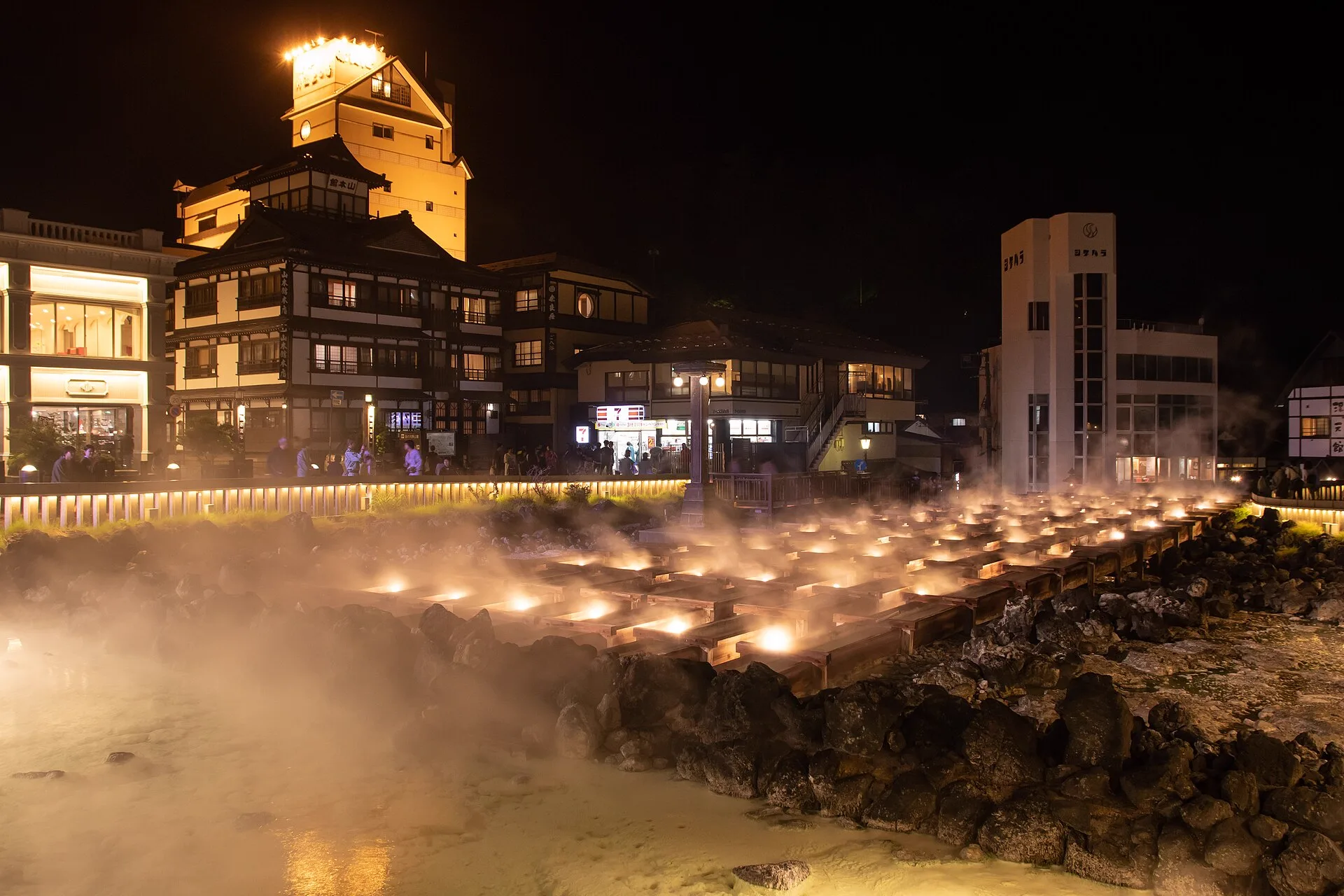
| After dinner | Make a short loop around the outer edge of Yubatake | The lights are lovely, but the evening is not always quieter. If it is crowded, leave the close-up photos for morning. |
| Next morning | Choose one shared bath on your route, then collect your bags | Shirahata, Chiyo and Jizo-no-yu each have cleaning arrangements; there is little need to squeeze all three into one visit. |
You do not have to cross all three areas in one day. Yubatake and Ura-Kusatsu work as one half-day; make Sainokawara the main outing if you want the park and its bath. Walking back and forth between them adds hills and sends you through the busiest centre more than once. The tourism association’s sample route estimates about 15 minutes from Yubatake to Sainokawara Open-Air Bath, and about 15 minutes back from the bath—before the park walk, changing or a rest.
The wooden flumes and the steps beside Yubatake are where people most often stop for photos. Agree to meet on the outer path rather than blocking a narrow edge. For a portrait, wait until you can step clear of the walkway; a full lap around the perimeter still gives you the main views without holding up foot traffic.
Shared-bath hours and small practical details
The free communal baths have no lockable lockers, so leave valuables at your accommodation. Do not take photos in the bathing area or occupy a tub for a long stretch when others are waiting.
| Bath | Walk from Yubatake | Published hours | Admission |
|---|---|---|---|
| Shirahata-no-yu | Beside Yubatake | 8 am–11 pm | Free |
| Chiyo-no-yu | About 2 minutes | 6 am–11 pm | Free |
| Jizo-no-yu | About 3 minutes | 8 am–10 pm | Free |
Shirahata and Jizo-no-yu have morning cleaning periods. Check the association’s current notices for Shirahata-no-yu and Jizo-no-yu, then follow the notice posted at each entrance. Bath hours alone do not mean every room is available throughout the day.
Sainokawara Open-Air Bath: check the date, not just the season
| Sainokawara Open-Air Bath | Published terms |
|---|---|
| April 1–November 30 | 7 a.m.–8 p.m. |
| December 1–March 31 | 9 a.m.–8 p.m. |
| Last entry | 7:30 p.m. |
| Adult admission | ¥900 |
| Child admission | ¥400 |
| From bus terminal | About a 20-minute walk |
Allow time for bathing, changing and the return walk before deciding whether it fits between buses.
Cleaning is scheduled for the second Wednesday of each month. The 2026 notice lists early closing at 5 pm, with last entry at 4:30 pm. October 14 and November 11, 2026 are listed as shortened days. If you are visiting on one of them, enter the park earlier or make it a walk rather than relying on a late soak. Check the latest operating notice; repair closures may be announced separately.
Day trip or overnight?
For a day trip, set your last stop by the bus you need to catch. If you reach Kusatsu in the morning, you can do Yubatake, lunch and Ura-Kusatsu before deciding whether there is time for Sainokawara. If you arrive in the afternoon or have only two or three hours, stay near the centre. In winter, cut the long walk to the open-air bath if the paths are snowy or icy.
An overnight makes it easier to split Yubatake into an evening stroll and a short return the next morning. Choose one shared bath on the way to pick up your bags; if Shirahata or Jizo-no-yu is being cleaned, head to the Ura-Kusatsu square instead. If some of your group wants to bathe while others browse, agree to meet on the outer path rather than beside a narrow bath entrance.
Rain or ice is a good reason to skip Sainokawara’s longer paths and stay around Yubatake, Ura-Kusatsu and your inn. In winter, visit the park before dark and keep the illuminated Yubatake walk short. For the timing trade-off in more detail, see the Kusatsu day-trip or overnight guide.
Staying near the centre
Hotel Ichii stands directly by Yubatake, which makes it easy to return to your room and come back for a second short walk. A central address does not clear the paths at busy times, though. Kusatsu Hotel 1913 is about a six-minute walk away; the return is uphill. Before choosing it with bulky luggage, sore knees or winter ice, check the hotel’s current shuttle and luggage arrangements.
Sources
- [Kusatsu Onsen Tourism Association: live cameras](https://www.kusatsu-onsen.ne.jp/live/index.php) - [Shirahata-no-yu](https://www.kusatsu-onsen.ne.jp/kankou/1097.php) - [Jizo-no-yu](https://www.kusatsu-onsen.ne.jp/kankou/1099.php) - [Chiyo-no-yu](https://www.kusatsu-onsen.ne.jp/kankou/1098.php) - [Sainokawara Open-Air Bath](https://www.kusatsu-onsen.ne.jp/kankou/1091.php) - [Monthly early-closing notice for bath cleaning](https://www.kusatsu-onsen.ne.jp/information/1942.php) - [Kusatsu spring and autumn visitor guide, 2026](https://www.kusatsu-onsen.ne.jp/pamphlet/pdf/kusatsu_26S_26A.pdf) - [Kusatsu Hotel 1913: access](https://www.kusatsuhotel.com/access) - Photo: Σ64, “Kusatsu Yubatake at night,” Wikimedia Commons, CC BY 4.0; cropped, resized and converted to WebP.Checked: September 27, 2026
Tags: Gunma, Kusatsu Onsen, Yubatake, Ura-Kusatsu, Sainokawara, crowd timing, public baths