Hiroshima Radon Onsen Guide: Choosing Between Four Day-Use Baths
Compare four Hiroshima radon baths by water, temperature, facilities and bus access, including the unheated 23.5°C cascade at Yunoyama.
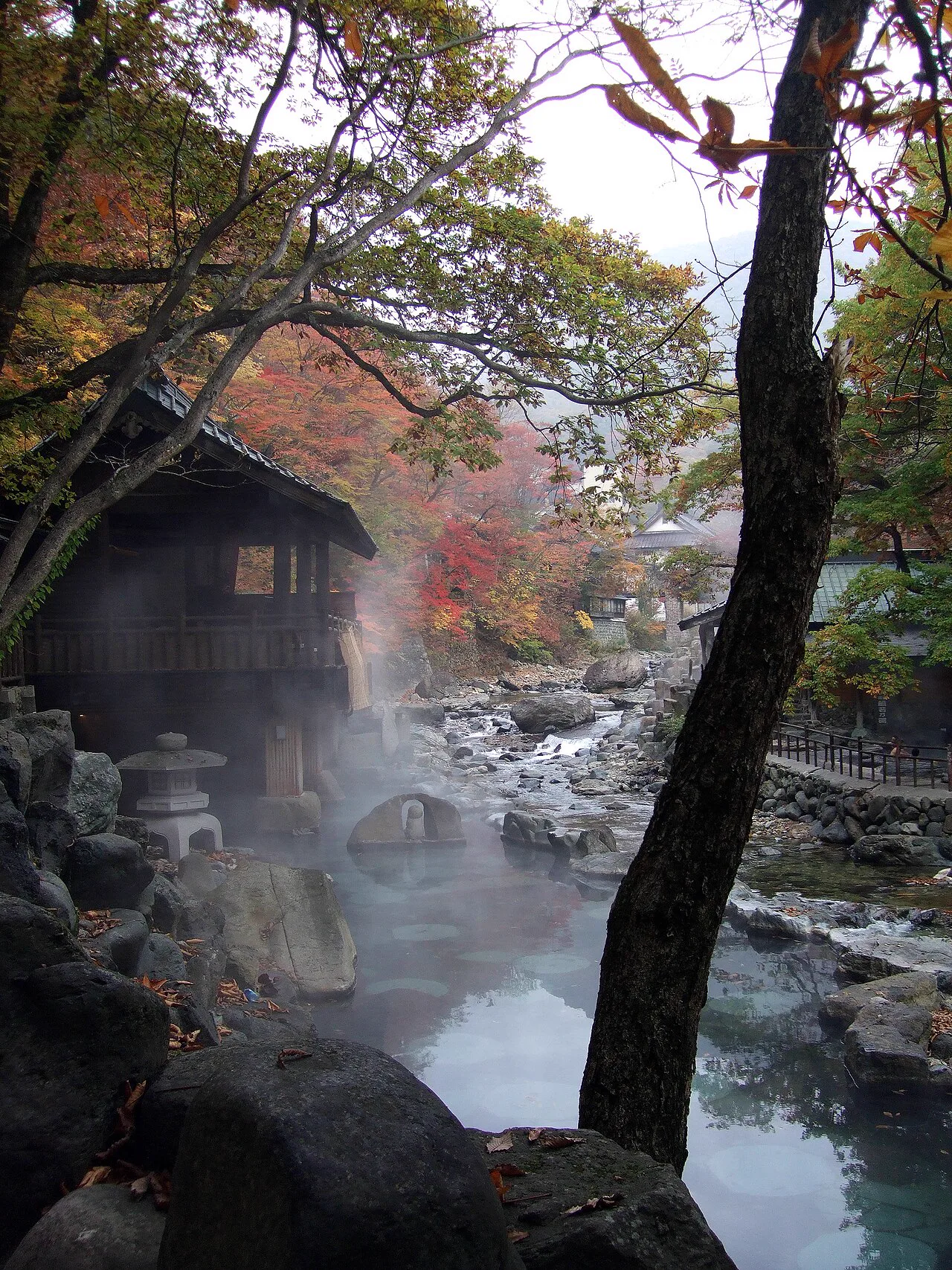
“Radon onsen” is a useful search term, but it does not tell you which pool uses which water or how that water is treated. Hiroshima has four day-trip options worth comparing. Their published records point to different experiences: a cold cascade at Yunoyama, a heated flow-through bath at Yuki Lodge, a larger bath-and-sauna complex at Takamiya, and a source-fed outdoor bath at Kurahashi.
Japanese hot-spring classifications describe water composition, not medical benefits. See the onsen spring-quality guide for the terms used in analysis records.
| Bath | What the records say | Adult admission | Best fit |
|---|---|---|---|
| Yunoyama Onsenkan | Simple weakly radioactive spring; 23.5°C source. The outdoor cascade is unheated; the indoor bath is about 41°C. | ¥450 one visit / ¥800 all day | A short, focused visit for the cold spring cascade |
| Yuki Lodge | Simple weakly radioactive spring; 28.3°C, pH 9.0. No added water, flow-through, with heating. | ¥750 one visit / ¥1,000 all day | A riverside bath, sauna and clearer water-treatment information |
| Takamiya Yunosato | Hiroshima Prefecture lists the Yamaodaira (Takamiya Onsen) source as a simple weakly radioactive cold spring. | ¥800 | A car-based visit with multiple baths and saunas |
| Kurahashi Katsuragahama Onsenkan | The 2023 source analysis classifies Kurahashi Onsen as weakly radioactive sodium-chloride spring water. The main Silver Bath has a separate sodium-chloride cold-spring classification. | ¥720 | A sea-facing outdoor bath, reached directly by bus from Kure |
What the published spring records tell you
Yunoyama’s spring is listed at 23.5°C and feeds the roughly four-metre outdoor cascade. The indoor tub is heated to about 41°C. For the difference between source and bath temperatures, see the onsen water-temperature guide.
| Visit detail | Current information |
|---|---|
| Adult admission | ¥450 for one visit; ¥800 all day |
| Through 30 September | 9am–9pm; last reception 8:30pm |
| 1 October–31 May | 9am–8pm; last reception 7:30pm |
| Regular closure | No fixed weekly closing day; maintenance closures may occur |
Yunoyama has a gender-separated indoor bath and the outdoor cascade, but no listed sauna or regular outdoor soaking pool. The bus from Itsukaichi Station South Exit to Ohashi takes about an hour, followed by a 30-minute walk. Alternatively, a local bus toward Usa leaves about a ten-minute walk away. Check the timetable before travelling; either route requires planning.
Yuki Lodge gives more treatment detail. Its spring is listed at 28.3°C and pH 9.0, and the lodge says it is used without dilution in a flow-through system, then heated. “Flow-through” does not mean the bath stays at source temperature.
| Visit detail | Current information |
|---|---|
| Adult admission | ¥750 for one visit; ¥1,000 all day |
| Towel | ¥200 |
| Through 30 September | 10am–9pm; last entry 8:30pm |
| 1 October–31 May | 10am–8pm; last reception 7:30pm |
The bathing rooms alternate by date. The cypress side has a high-temperature dry sauna; the marble side has a mist sauna. Yuki Lodge also has a riverside outdoor bath. The public bus from JR Itsukaichi Station takes about 75–76 minutes; the listed last return leaves at 7:30 p.m. on weekdays and 6:40 p.m. on weekends and holidays. Its free Hiroshima Station shuttle is reserved for overnight guests and must be booked.
Takamiya’s radon label needs a pool-level caveat
Takamiya Yunosato describes itself as a natural radon onsen. In Hiroshima Prefecture’s 2026 hot-spring usage report, the Yamaodaira source associated with Takamiya Onsen is classified as a simple weakly radioactive cold spring. That supports the spring classification, but the facility does not publish a full, pool-by-pool treatment sheet showing that every bath uses the same source in the same way.
The distinction matters here because the complex has several designed baths. Its outdoor carbonated bath has carbon dioxide added to the natural-radon spring; it is not a naturally carbonated spring. Other baths add mineral elements extracted from granite, and the two sides of the bathing area rotate between men and women on alternate days.
| Visit detail | Current information |
|---|---|
| Adult admission | ¥800 |
| Children | ¥400 from age four to under junior high school; free at age three and under |
| Hours | 10am–9pm; last bathing reception 8:30pm |
| Regular closure | Second Tuesday of each month |
| Payment and amenities | Cash only; towels extra; shampoo, conditioner and body wash supplied |
The facility’s access information gives a five-minute drive from Takata Interchange, but no direct station-to-bath public transport route is listed there. Treat it as a car-first stop unless you have arranged a local connection.
Kurahashi: the outdoor Gold Bath and indoor Silver Bath differ
Kurahashi is the easiest of these four to mislabel as one single “radon bath.” Its operator says the outdoor Gold Baths use 100% of Kurahashi Onsen, pumped from 1,650 metres underground. A 2023 source analysis classifies that water as a weakly radioactive sodium-chloride spring. The main indoor Silver Bath has a separate 2023 analysis and is classified as a sodium-chloride cold mineral spring. So the weak-radioactivity label for the source should not be applied automatically to every pool.
The baths occupy the first and third floors, and the men’s and women’s areas switch weekly. The operator lists indoor tubs, item baths and a sauna, with the precise facilities varying by side.
| Visit detail | Current information |
|---|---|
| Adult admission | ¥720 |
| Children | ¥360 for elementary-school age; ¥240 from age four to preschool; free at age three and under |
| Hours | 10am–9pm; last admission 8pm |
| Regular closure | Monday, or Tuesday when Monday is a public holiday |
For a no-car visit, take the Hiroden Kure-Kurahashi Island Line from Kure Station’s bus stop 3 to Katsuragahama Onsenkan. The destination is the onsen itself, rather than a stop followed by a long walk. Check the current return timetable before committing to the trip: a direct route does not guarantee a convenient evening service. By car, this works better as part of a Kure or Kurahashi day than as a quick soak from central Hiroshima.
Which one makes sense without a car?
Kurahashi has the clearest direct bus approach from Kure, but the timetable still controls how long you can stay. Yuki Lodge is reachable from Itsukaichi, though the ride and early final return make it a full outing. Yunoyama adds either a long walk or a local-bus transfer after the train-and-bus journey. Takamiya is the least straightforward without a car; its official directions focus on road access.
If the trip is primarily about checking a spring label against a bathing experience, Yunoyama and Yuki Lodge publish the clearest distinction between source temperature and treatment. Choose Takamiya for its bath variety, not because every pool has a separately documented radon analysis. At Kurahashi, head for the outdoor Gold Bath if the source classification is the point of the visit; the Silver Bath is a different water record.
For a shorter soak closer to town, see the Hiroshima Station evening onsen guide. If Kurahashi is part of a Miyajima-side itinerary, the onsen options after Miyajima may fit the route better.
Sources
- [Yunoyama Onsenkan: spring, baths, current admission and seasonal hours](https://www.yuki-lodge.jp/yunoyamaonsenkan.html) - [Dive! Hiroshima: Yunoyama access by bus and on foot](https://dive-hiroshima.com/explore/1167/) - [Yuki Lodge: spring data, water treatment, bath rotation and fees](https://yuki-lodge.jp/onsen.html) - [Yuki Lodge: day-trip bus, travel time and final return services](https://yuki-lodge.jp/access.html) - [Takamiya Yunosato: baths, admission, payment, hours and closures](https://www.yunomori.net/hotspring) - [Takamiya Yunosato: road access](https://www.yunomori.net/access) - [Hiroshima Prefecture: 2026 hot-spring usage report (PDF)](https://www.pref.hiroshima.lg.jp/uploaded/life/1115048_9622486_misc.pdf) - [Kurahashi Katsuragahama Onsenkan: bath descriptions, source use, fees and hours](https://icou-kurahashi.com/katsuragahama-spa) - [Kurahashi Onsen analysis: main bath, sampled 25 April 2023](https://icou-kurahashi.com/pdf/bunseki01.pdf) - [Kurahashi Onsen analysis: source, sampled 25 April 2023](https://icou-kurahashi.com/pdf/bunseki02.pdf) - [Kure City: access from Kure Station by Hiroden bus](https://www.city.kure.lg.jp/soshiki/33/kurasis01.html) - [Hiroden: Kure-Kurahashi Island Line](https://www.hiroden.co.jp/bus/route/k-1.html)Checked: 27 September 2026. Seasonal hours and bus timetables can change; confirm them with the operator before travelling, especially around the 1 October schedule change. Tags: Hiroshima radon onsen, Hiroshima weakly radioactive spring, Hiroshima onsen day trip, Yunoyama Onsenkan, Yuki Lodge, Takamiya Yunosato, Kurahashi Katsuragahama Onsenkan, Hiroshima hot springs, Hiroshima spring quality, Japanese onsen, onsen water temperature, onsen flow-through, Kure travel, Hiroshima without a car, Hiroshima travel guide