Makuhari Onsen Yuraku no Sato: Tokyo Bay Views, Spring Water and Getting There
Plan a visit to Makuhari’s Tokyo Bay-facing spring baths with current admission details, towel costs and the limited courtesy-bus schedule.
Updated September 2026
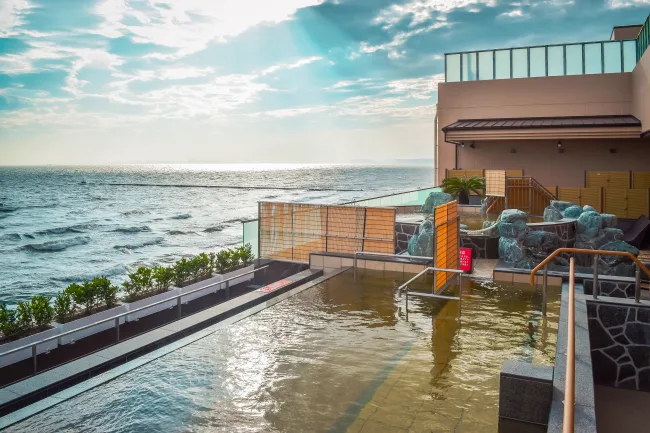
JFA Dream Field Makuhari Onsen Yuraku no Sato has one clear reason to make the trip: its outdoor baths look out towards Tokyo Bay, and two of them use the facility’s natural spring. The setting works particularly well after an event around Makuhari or for anyone already travelling on the Keiyo Line. It is a less convincing detour if you want a traditional hot-spring town, a late-night place to sleep, or an easy walk from the station.
The open-air Ue no Yu and Shita no Yu use a highly saline iodide-sodium-chloride spring drawn from about 2,000 metres underground. Their supply is listed as a combination of fresh flow and circulation. That is natural spring water, but it is not the same claim as a 100% source-flow bath.
Start with the basic bath ticket
| Basic adult ticket | Weekday | Weekend/public holiday |
|---|---|---|
| Admission | ¥1,300 | ¥1,600 |
The ticket includes the bathing areas, spring baths, artificial carbonated bath, massage tubs and sauna. You may return to the baths during the same visit, provided you have not left the facility.
Towels are not rented. A face towel costs ¥250 and a bath towel ¥350 to buy; bring your own to avoid the ¥600 combined purchase.
| Onnetsubo bedrock-bath add-on | Weekday | Weekend/public holiday |
|---|---|---|
| Add-on | ¥600 | ¥700 |
| Adult total with basic admission | ¥1,900 | ¥2,300 |
The area has eight mineral rooms, heated-floor rest areas and a women-only room. It opens 9 a.m.–11:30 p.m. (last admission 11 p.m.). It suits a longer visit better than a quick soak.
Current fees and any date-specific pricing are listed on the facility’s fee page.
A view worth timing around the weather
The bay-facing outdoor baths are the feature that separates Makuhari from a generic urban spa. On a clear day the open horizon adds something to a soak; wind, haze and rain can change the mood quickly. The bathing area is not a photo stop: phones and other electronic devices are prohibited in the changing rooms, baths and bedrock rooms.
Not every pool is natural spring water. The indoor high-concentration carbonated bath is an artificial CO₂ bath, listed at around 1,000 ppm and about 37°C. Treat the spring baths, carbonated bath and massage pools as different options rather than assuming the facility’s many tubs all use the same water.
The station is a 20-minute walk, not a doorstep
Kaihin-Makuhari Station is about a 20-minute walk away. The facility also runs a free courtesy bus from the area in front of Plena Makuhari and the Marines Store. Its published timetable is concentrated during the day, with gaps between some trips and limited seating. It is not an all-day shuttle; check the current bus timetable before planning to visit after a concert, game or exhibition.
If you miss the bus, walking is the fallback, but allow the full 20 minutes and account for weather. The facility lists around 200 free parking spaces for customers. The lot is for spa users only, not a free place to leave the car while visiting the coast or the exhibition grounds. Full directions and parking rules are on the access page.
A few entry rules to settle before you go
The facility does not admit guests with tattoos, including tattoo stickers; no cover-sticker exception is listed. Wheelchairs can be used as far as the changing room, but not inside the bathing area. If either rule affects your plans, check directly with the facility before setting off. Its visitor guidance also covers age and bathing-area restrictions.
For a short visit, head for the outdoor spring baths and leave the bedrock area out of the plan. With a longer window, alternate bathing and rest, then add Onnetsubo if the extra time is genuinely welcome. That pacing suits the place better than trying to tick off every pool.
Makuhari’s appeal is fairly focused: sea-facing outdoor baths, natural saline spring water and a location that fits a day already spent around the bay. If you need manga, a proper overnight option or a station-side facility, Yuneru at Shin-Narashino has a different setup. For a larger sauna-led outing, Spa Metssa Otaka is the more relevant comparison.
Sources
- [Makuhari Onsen Yuraku no Sato: official site](https://www.yurakirari.com/makuhari/), [fees](https://www.yurakirari.com/makuhari/fee/) and [baths and spring](https://www.yurakirari.com/makuhari/spa/) - [Onnetsubo bedrock baths](https://www.yurakirari.com/makuhari/ganban/) - [Visitor guidance](https://www.yurakirari.com/makuhari/about/), [access](https://www.yurakirari.com/makuhari/access/) and [courtesy-bus timetable](https://www.yurakirari.com/makuhari/files/access/courtesy_bus.pdf) - [Japan Football Association: JFA Dream Field Makuhari Onsen Yuraku no Sato](https://www.jfa.jp/news/00025074/) - [Spa Sun Fuji / PR TIMES: opening announcement and image source](https://prtimes.jp/main/html/rd/p/000000002.000043281.html)Checked September 27, 2026.