Beppu Onsen in One Night: A Three-Bath Itinerary for Kannawa and Myoban
Plan one night in Beppu around Kannawa’s stone-chamber steam bath, a Myoban sulfur or mud bath, and the spring at your ryokan.
Trying to visit every kind of onsen in Beppu in one afternoon turns the trip into a race between baths and buses. For a one-night stay, a more workable plan is to try Kannawa’s traditional steam bath, choose one bath in Myoban, then make your accommodation the final stop. The mud bath and sulfur-spring bath are both in Myoban; pick one rather than squeezing in both.
These are distinct bathing experiences, not three pools filled from the same source. Kannawa Mushiyu’s stone chamber uses a simple hot spring, while its tub is a sodium-chloride spring. Myoban Yunosato’s open-air bath is a sulfur spring. Your third bath depends on the property: Nihon Ryokan Utsuwa uses a sodium-chloride spring, Beppu Showaen a sodium-sulfate and bicarbonate spring, and Onyado Nono Beppu its own Beppu hot-spring source.
| Stop | What you bathe in | Best role in the itinerary |
|---|---|---|
| Kannawa Mushiyu | Stone-chamber steam bath over aromatic sekisho leaves; the separate tub is a sodium-chloride spring | Start here, then shower, drink water and rest |
| Beppu Onsen Hoyoland, Myoban | Konya mineral mud bath; separate colloid bath with sulfur spring water | The choice if you specifically want a mud bath; unpotty-trained children cannot enter the mud bath |
| Myoban Yunosato | Open-air rock bath with sulfur spring water | The simpler sulfur-bath option; choose it instead of Hoyoland |
| Your ryokan or hotel | Varies by property | Finish close to where you are sleeping, without another cross-district trip |
Start in Kannawa with the steam bath
Kannawa Mushiyu's hours depend on the season. The city lists these current schedules and admission details:
| Detail | Current information |
|---|---|
| July 1–September 30, 2026 | 7:30 am–7:30 pm; last reception 7 pm |
| Regular hours outside that period | 6:30 am–8 pm; last reception 7:30 pm |
| Monthly closure | Fourth Thursday; if it is a public holiday, the bath closes the following day |
| Steam-bath admission | ¥700 per person, ages 13 and over |
| Yukata rental | ¥220; you may bring a T-shirt and shorts instead |
| Steam-chamber capacity | Up to four people of each gender at a time; waits are possible when busy |
Check the city notice before setting out, since hours can change. The chamber is heated by hot-spring steam, with sekisho leaves spread over the stone floor.
On weekdays, Route 24 leaves Beppu Station stop 5 at 1:08 pm and reaches Kannawa at 1:29 pm. After the steam bath, shower, drink water and take a proper break before heading to Myoban.
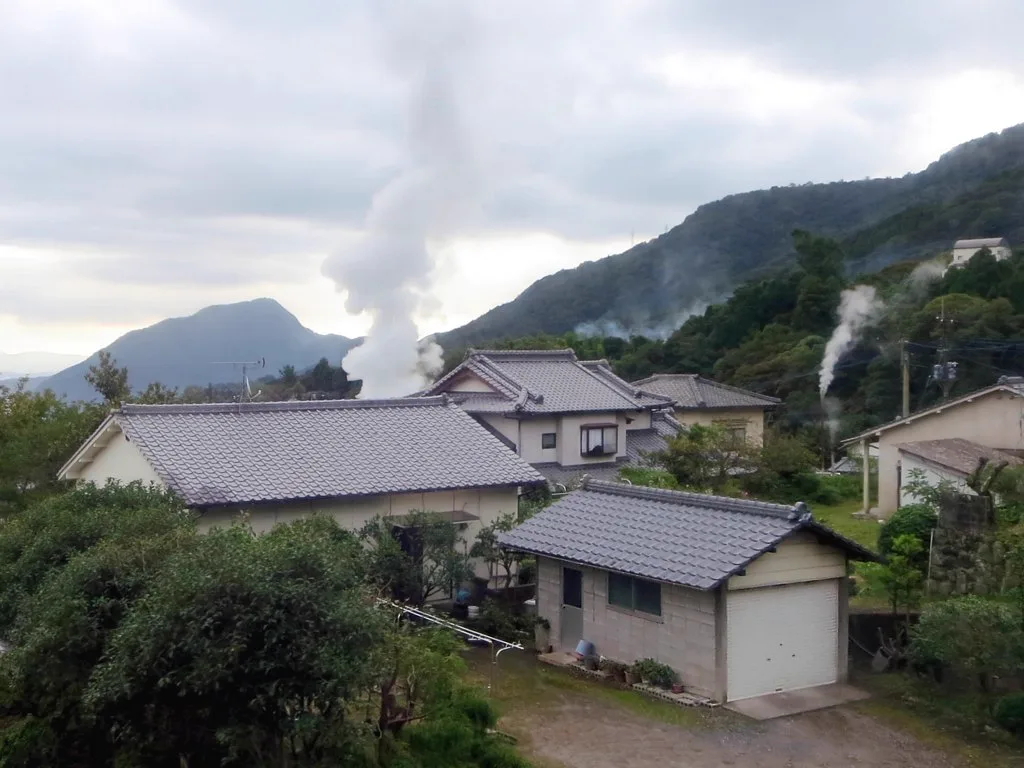
Kannawa’s streets are lined with geothermal steam vents, and local restaurants use the steam for jigoku-mushi cooking. Self-service cooking takes longer than ordering a prepared meal because you choose the ingredients and monitor the pot. Check the restaurant’s serving hours and equipment rules before making it part of the bus schedule.
In Myoban, choose mud or sulfur water
For a sulfur bath, allow about 90 minutes at Myoban Yunosato. The following Route 24 example gives you 1 hour 48 minutes between arriving at Myoban and boarding the return bus, including bathing and changing:
| Route 24 leg | Weekday | Saturday, Sunday and public holiday |
|---|---|---|
| Leave Beppu Station, stop 5 | 3:08 pm | 3:08 pm |
| Arrive at Kannawa | 3:29 pm | 3:29 pm |
| Arrive at Myoban | 3:38 pm | 3:38 pm |
| Leave APU on the return bus | 5:16 pm | 5:16 pm |
| Leave Myoban on the APU-origin return bus | 5:26 pm | 5:26 pm |
| Pass Kannawa | 5:35 pm | 5:34 pm |
| Arrive at Beppu Station | 5:57 pm | 5:56 pm |
Both columns are from Kamenoi Bus timetables effective March 14, 2026. The schedule is a planning example, not a guarantee; check the current PDF for your travel date.
Myoban Yunosato’s large open-air rock bath and indoor bath are normally open 10 am–8 pm, with reception closing at 7 pm. Weather can affect operations. The operator announced an admission-fee revision effective April 13, 2026, so check its latest notice or ask at reception for the current price. The bath looks toward the Myoban Bridge and Mount Tsurumi area. After the earlier steam bath, one sulfur soak is enough for this compact schedule; leave time to rinse and change before the return bus.
If you prefer a mud bath, get off Route 24 at Konya Jigoku-mae for Beppu Onsen Hoyoland rather than continuing to Yunosato. Day use is 9 am–8 pm and adult admission is ¥1,500. Visitors who are not toilet-trained cannot use the mineral mud bath, but may use the separate colloid bath. Check the return bus to Kannawa or Beppu Station: the 5:16 pm departure from APU is not the return plan for Hoyoland. Leave time to rinse and change before boarding.
Do not assume the walk between Kannawa and Myoban is easy just because the districts look close on a map. The route climbs, and walking downhill after a hot bath is a poor fallback if you miss your bus. If you are staying at Showaen, confirm its pick-up point and reservation time in advance: the ryokan shuttle is not a stop on Route 24.
Let your accommodation decide the third bath
For a Kannawa base, Nihon Ryokan Utsuwa in Beppu Kannawa has a private, in-room hot-spring bath in both its main building and detached annex rooms. The source is a sodium-chloride spring. Room categories differ in space, views and shared facilities: the detached annex has its own indoor and outdoor baths, while benefits such as the main building’s larger private outdoor bath and rooftop footbath should not be assumed to come with an annex booking. Staying in Kannawa means you can finish bathing without returning to central Beppu that evening.
If you want to stay beside the station, Onyado Nono Beppu is next to Beppu Station. Its 13th-floor public bath uses the hotel’s own Beppu spring. There are also seven private baths: five natural hot-spring baths and two silky-bath tubs. They are first come, first served, with stays of about 45 minutes; availability is not guaranteed when you arrive in the evening. Treat the public bath as your planned third soak and use a private bath only if one is free.
Beppu Showaen keeps the bath, dinner and next morning on the ryokan grounds. Its detached rooms each have a natural hot-spring bath, supplied by a sodium-sulfate and bicarbonate spring. Two private outdoor baths are free for 50-minute sessions and are assigned in check-in order.
Showaen is away from Beppu Station. Its guest shuttle runs at set times between the ryokan, the station and Kitahama, so confirm a transfer that fits your arrival before choosing it as your base.
Sample costs for two adults
| Item | Cost | Notes |
|---|---|---|
| Kannawa Mushiyu | ¥1,400 | Two adult admissions at ¥700 each |
| Yukata rental at Mushiyu | ¥440 | Two rentals at ¥220 each; bring a T-shirt and shorts to avoid this charge |
| Hoyoland mud bath, if chosen | ¥3,000 | Two adult admissions at ¥1,500 each |
The Mushiyu visit with two rentals totals ¥1,840. Adding Hoyoland brings the two-bath total to ¥4,840. Bus fares, meals and accommodation are extra. Plan around your ryokan’s latest dinner seating and the last bus you can catch. The next morning, Onyado Nono’s public bath closes at 10 am; Utsuwa guests can use their in-room bath, while Showaen guests need to fit a final soak around the reserved shuttle. Confirm breakfast and checkout times with your property.
When to skip the third bath
If Beppu is a day stop between Oita and Yufuin, Kannawa’s steam bath plus one Myoban bath already gives you two contrasting bathing styles. The extra ride and bath can make a day trip depend too tightly on bus connections. With an overnight stay, the hotel bath becomes a third session after you have checked in, so there is no need to travel again after the Myoban stop.
If you arrive late in the afternoon or face a long wait at Mushiyu, drop Myoban. Have dinner in Kannawa, take a short walk through the steam-filled streets, then use your accommodation’s bath. One planned soak is better than missing the bus or arriving too late for dinner. There is no need to chase a fourth spring the next morning.