Awara Onsen Water Sources Compared: Grandia Hosen, Haiya and Matsuya Sensen
Compare spring-water sourcing at Grandia Hosen, Haiya and Matsuya Sensen; Awara ryokan may use different wells in room and public baths.
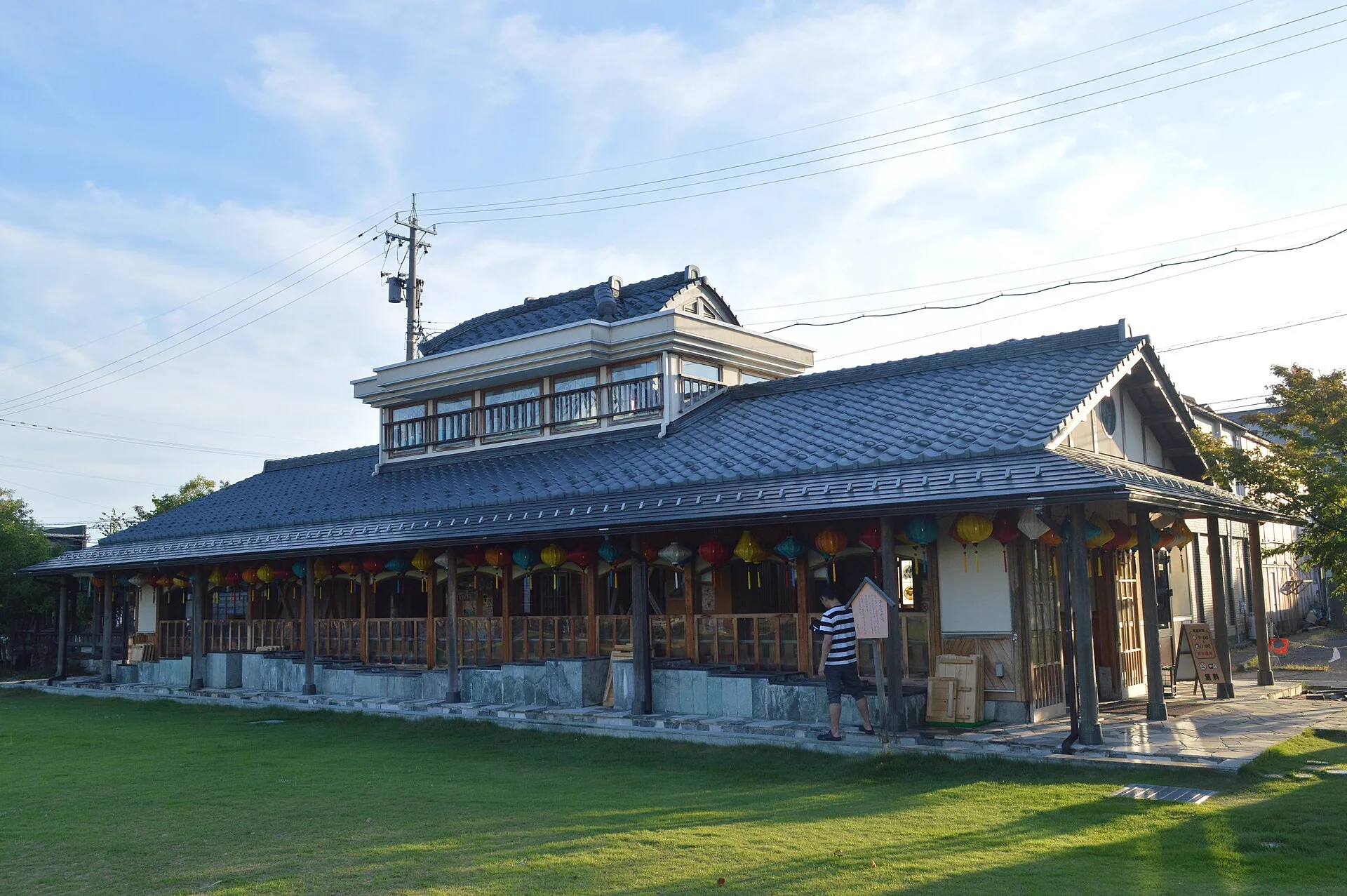
Photo: Asturio Cantabrio, Ashiyu public footbath.jpg), CC BY-SA 4.0. The photo shows a town footbath, not one of these inns.
Start with how each inn supplies its baths, not which one has the “best” spring. A source analysis is a snapshot at the well, not a rating of the water you will find in every tub.
Awara’s system is limited to 74 wells, and the inns do not share one centrally managed water supply. These three properties publish different levels of detail: Grandia Hosen has three named wells and a bath-use chart, Haiya describes its own on-site spring, and Matsuya Sensen identifies a three-well blend for its large public bathing area.
What the published spring data can—and can’t—tell you
| Inn | Water guests can compare | Source data | What the bath information says |
|---|---|---|---|
| Grandia Hosen | Wells No. 29, 39 and 51 | 27.2°C, 26.3°C and 31.0°C; pH 8.8, 9.0 and 8.6. All are classified as low-mineral alkaline simple springs. | Its bath chart maps wells to selected public baths, footbaths and rooms, and lists dilution, heating, filtration and disinfection. The chart is dated July 2017. |
| Haiya | The inn’s own on-site source | Sodium-chloride spring, described as weakly saline; the inn lists bath water at around 40°C. It does not publish a well number, source temperature, pH or bath-by-bath supply chart. | Two public-bath areas include indoor and outdoor bathing. The inn does not state which source supplies each individual tub. |
| Matsuya Sensen | A blend of wells No. 14, 43 and 64 | 29.3°C, pH 7.9; sodium-calcium chloride spring, classified as low-mineral, weakly alkaline and low-temperature. | The large public baths use the blended spring and are recirculated. Different tubs offer different ways to bathe, not a separate well for each one. |
Those temperatures belong to the source water, except Haiya’s figure, which is the bath temperature listed by the inn. They are not directly comparable as a measure of how warm the baths feel. Nor should the published flow rates for Grandia Hosen’s wells be read as the water entering each tub per minute.
Grandia Hosen: the clearest well-to-bath chart
Grandia Hosen’s analysis sheets give the following source-level figures. They are not measurements of water flowing into each bath.
| Well | Flow rate | Sensory note | Analysis date |
|---|---|---|---|
| No. 29 | 15.3 L/min | Faint hydrogen-sulfide smell | July 2, 2015 |
| No. 39 | 77 L/min | No odour | July 2, 2015 |
| No. 51 | 69.1 L/min | Faint hydrogen-sulfide smell | March 12, 2014 |
These are observations at the source, not a promise that a guest will notice a particular smell in the bath.
Grandia Hosen’s bath-use chart is dated July 2017. It assigns well No. 29 to the footbath and some open-air guest-room baths, No. 39 to the Kotobukitei cypress bath and some rooms, and No. 51 to the Tenjo Spa and two listed room baths. The chart also records added water, heating, circulation, filtration, and chlorine- and bromine-based disinfection.
Room categories and well assignments may have changed since 2017. Treat the chart as a dated reference, and ask the inn which source serves the room you plan to book.
The public baths still make it possible to experience more than one of the inn’s sources without changing hotels. A private open-air tub is mainly about privacy and being able to bathe on your own schedule; it does not automatically mean you will get a different spring. Grandia Hosen’s current room list includes several categories with open-air hot-spring baths, but the 2017 chart should not be used to infer the well for a newer room.
The station shuttle is free but must be reserved. Current listed departures from JR Awara-Onsen Station run between 2:30 and 4:30 p.m. every half hour. Return trips leave the inn from 9:00 to 11:00 a.m., also every half hour. If you need an earlier train, plan another way back rather than assuming the shuttle can leave outside those times.
Haiya: an on-site spring, with less well-level detail
Haiya says its baths use a natural spring from the property. It classifies the water as a sodium-chloride spring, or weak saline spring, and lists a bathing temperature of around 40°C. Unlike Grandia Hosen, it does not publish a well number, source temperature, pH or a chart showing which spring feeds each individual bath. If you are choosing a room for a specific water source, ask the inn directly; the public information does not establish that every in-room tub uses the natural spring.
Haiya’s two public-bath areas have indoor and outdoor tubs, including a reclining bath. Overnight guests can also use the garden sauna; men’s and women’s hours alternate.
The private bath has an open-air tub and sauna. It costs ¥5,000 for 60 minutes, with the last session listed at 10:30 p.m. The wash area is step-free, with handrails and extra space in the toilet and changing area. Confirm availability and any support you need when booking.
Haiya’s free station pickup currently runs from 2:00 to 6:00 p.m. and needs to be arranged by phone. The inn does not list a matching morning drop-off timetable, so check your return transport before relying on a shuttle for an early departure.
Matsuya Sensen: several tubs, one blended spring
Matsuya Sensen’s public baths draw on a blend from wells No. 14, 43 and 64. The inn lists a source temperature of 29.3°C, pH 7.9 and a sodium-calcium chloride classification. Its baths are recirculated. The larger bathing areas include indoor and outdoor tubs, soaking tubs and other formats; the women’s area has a different selection from the men’s. That gives you variety within one visit, though not a different source for every tub.
The baths are open 2 p.m.–1 a.m. and 5–10 a.m. Sauna hours are 3–10 p.m. and 6–9 a.m.
Free pickup runs from JR Awara-Onsen or Echizen Railway’s Awara-Yunomachi Station between 2 and 6 p.m. Return shuttles leave the inn at :00 and :30 from 8 to 11 a.m., via Yunomachi to Awara-Onsen Station. If you need an earlier train, arrange another way back.
Which spring setup suits your stay?
Choose Grandia Hosen if you want the clearest published record of multiple wells and where they were used, while accepting that its bath chart is from 2017. Haiya fits travellers drawn to an inn-owned source or a bookable private bath, though public well-level details are limited. Matsuya Sensen is the straightforward pick if you want a large choice of bathing styles and are comfortable with the public baths sharing a blended, recirculated supply.
For a broader look at the bathing styles and practical differences between Awara inns, see the Awara ryokan comparison guide.
Sources
Checked: September 27, 2026. - [Awara Onsen Ryokan Association: spring sources are managed by individual inns](https://www.awara-onsen.org/about/) - [Grandia Hosen: well analyses and bath-use chart (chart dated July 14, 2017)](https://www.g-housen.co.jp/hot-spring/effect/) - [Grandia Hosen: current guest-room categories](https://www.g-housen.co.jp/room/) - [Grandia Hosen: current shuttle timetable and reservation requirement](https://www.g-housen.co.jp/access/) - [Haiya: spring classification, bath temperature, private bath and facilities](https://www.haiya.jp/spa/) - [Haiya: station pickup information](https://www.haiya.jp/access/) - [Matsuya Sensen: spring data and bathing hours](https://matuyasensen.co.jp/spa/) - [Matsuya Sensen: shuttle schedule](https://matuyasensen.co.jp/access/)Tags: Awara Onsen, Fukui onsen ryokan, Grandia Hosen, Haiya, Matsuya Sensen, hot spring water source